
a new citizen of Singletonville?
Bending Spoons, the $20 billion Italian acquirer behind Evernote, WeTransfer, Vimeo, and AOL, just filed to go public. It models itself on history's great capital allocators.

Hi, I’m Etienne. I invest into startups and public companies, and build AI systems for businesses through Ontara. Brick+Code is where I analyze how the software and physical economies are getting rebuilt, and who’s doing the rebuilding. Today: Bending Spoons, the Italian acquirer that just filed to go public, and whether it belongs in the lineage of great capital allocators it claims.
the compounders’ club
Establishing and maintaining an unconventional approach requires frequently appearing downright imprudent in the eyes of conventional wisdom.
— David Swensen, CIO, Yale University Endowment
Most of the energy in tech flows to the new thing. The founder with the blank page, the product that didn’t exist last year. I get the appeal. But there’s another model I find just as compelling. You take something that already works, that someone built well and then let drift, and you make it better through nothing more glamorous than discipline. Buy the asset. Install real management. Raise the floor. Compound. Do it again.
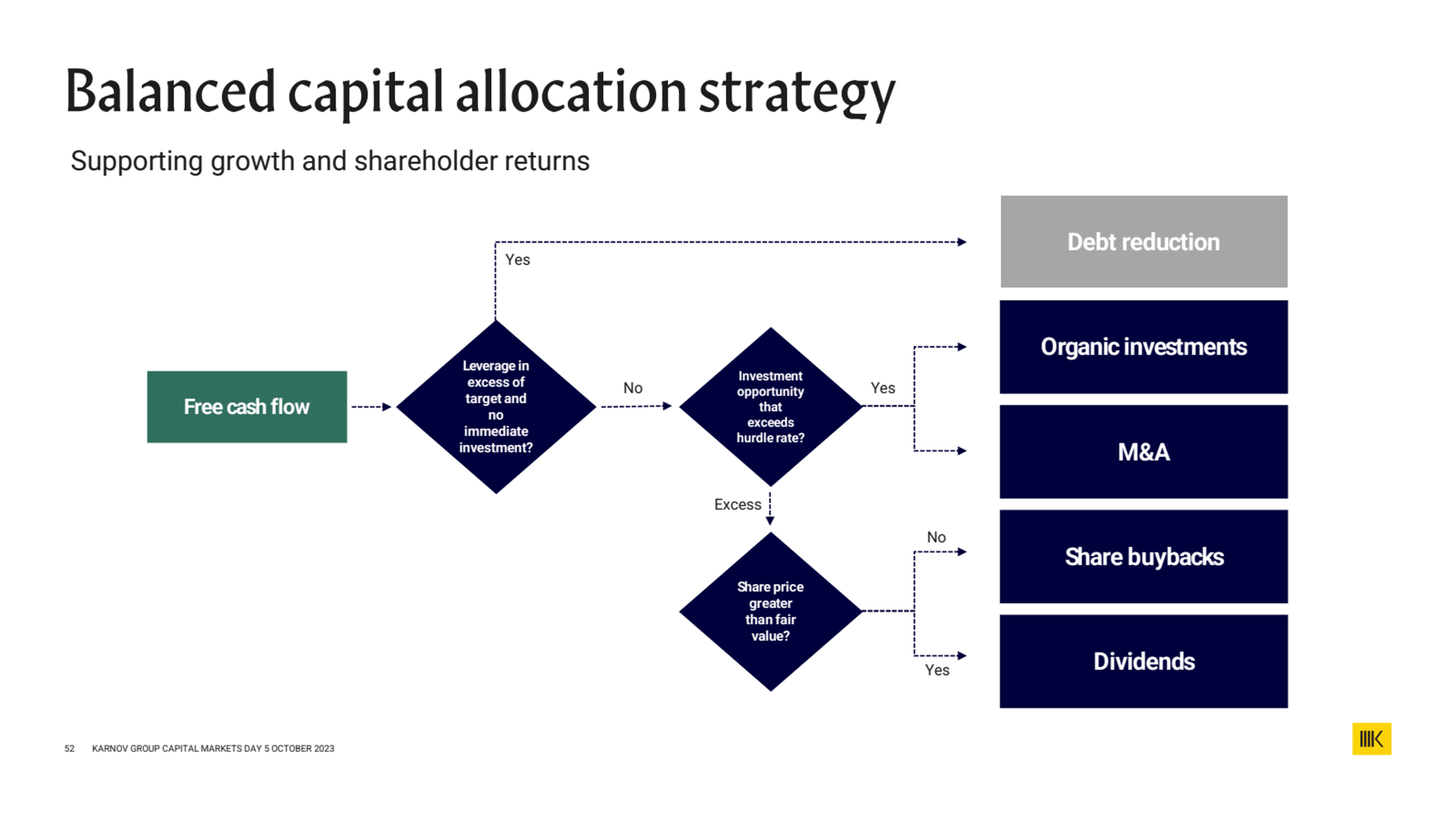
My favorite business book is about exactly this. William Thorndike’s The Outsiders profiles eight CEOs whose companies marginally outperformed the market by being exceptional at capital allocation, or what to do with the cash a business throws off. Buy back stock when it’s cheap. Acquire when the returns beat the alternatives. Reinvest only above a hard hurdle rate. Otherwise, wait.
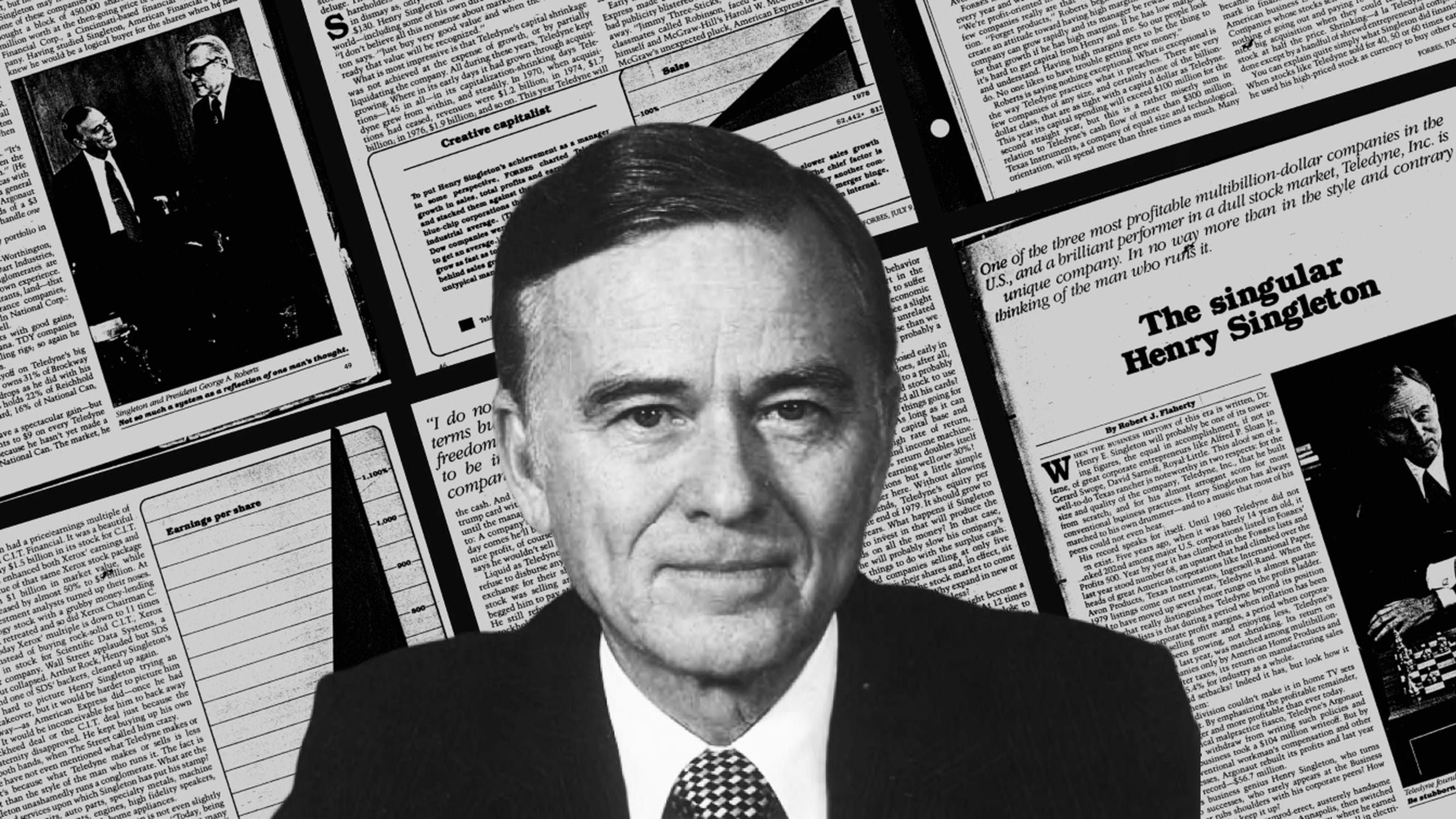
William Thorndike calls this shared worldview Singletonville. The name is a nod to Henry Singleton, the Teledyne CEO Thorndike treats as the archetype. Singleton built a conglomerate through the 1960s by issuing expensive stock to buy businesses, then spent the 1970s and early ‘80s doing the exact reverse, buying back roughly 90% of Teledyne’s shares once they got cheap.
The citizens of Singletonville believe a handful of things:
Decentralized operations: decision-making is pushed to the frontlines
Centralized capital allocation: HQ sets decisions
Buybacks and acquisitions: buy your own stock if it’s trading low, use it for M&A if it’s trading high
Limited payouts: over the long run, reinvestments, acquisitions and buybacks should create more shareholder value than dividends
Low-profile and independent: shun the limelight and think for yourself
They were patient for years and then aggressive in an afternoon. They compounded fortunes by being right and disciplined.
I’ve spent a lot of time in this lane – studying serial acquirers, investing in a few, and through Ontara, building the AI infrastructure a new wave of upstart acquirers increasingly runs on. I wrote deep dives on QXO*, Brad Jacobs’s building-products rollup that’s built eight billion-dollar companies on this loop, and The Vertical AI Playbook, on technologists using AI to buy and operate businesses instead of just selling them software.
So the question that nags at me is who runs the Singletonville playbook today, in software. The obvious answer is Constellation Software, which has compounded at ~30% a year for two decades buying boring vertical-software companies and never selling them. Lately, though, the market’s gotten nervous about this model due to fears of AI commoditization, and Constellation and its peers now trade well off their highs.
Then, last week, as the markets were fixated on the largest IPO in history, a company in Milan filed to go public running that playbook on something new: not mission-critical enterprise software, but legacy consumer internet apps. Funded with real leverage. And, it turns out, supercharged by AI in a way none of the original Outsiders could have imagined.
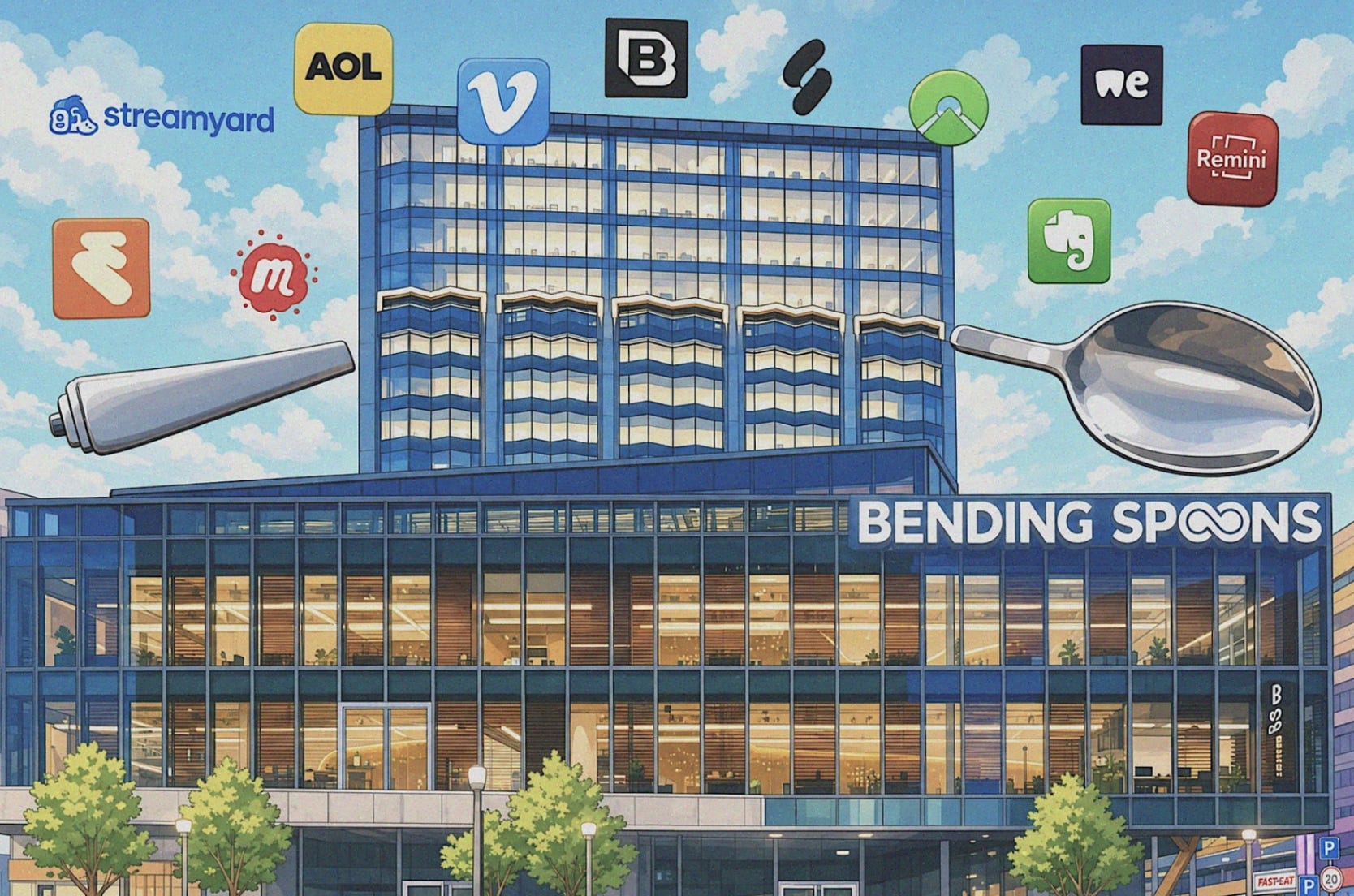
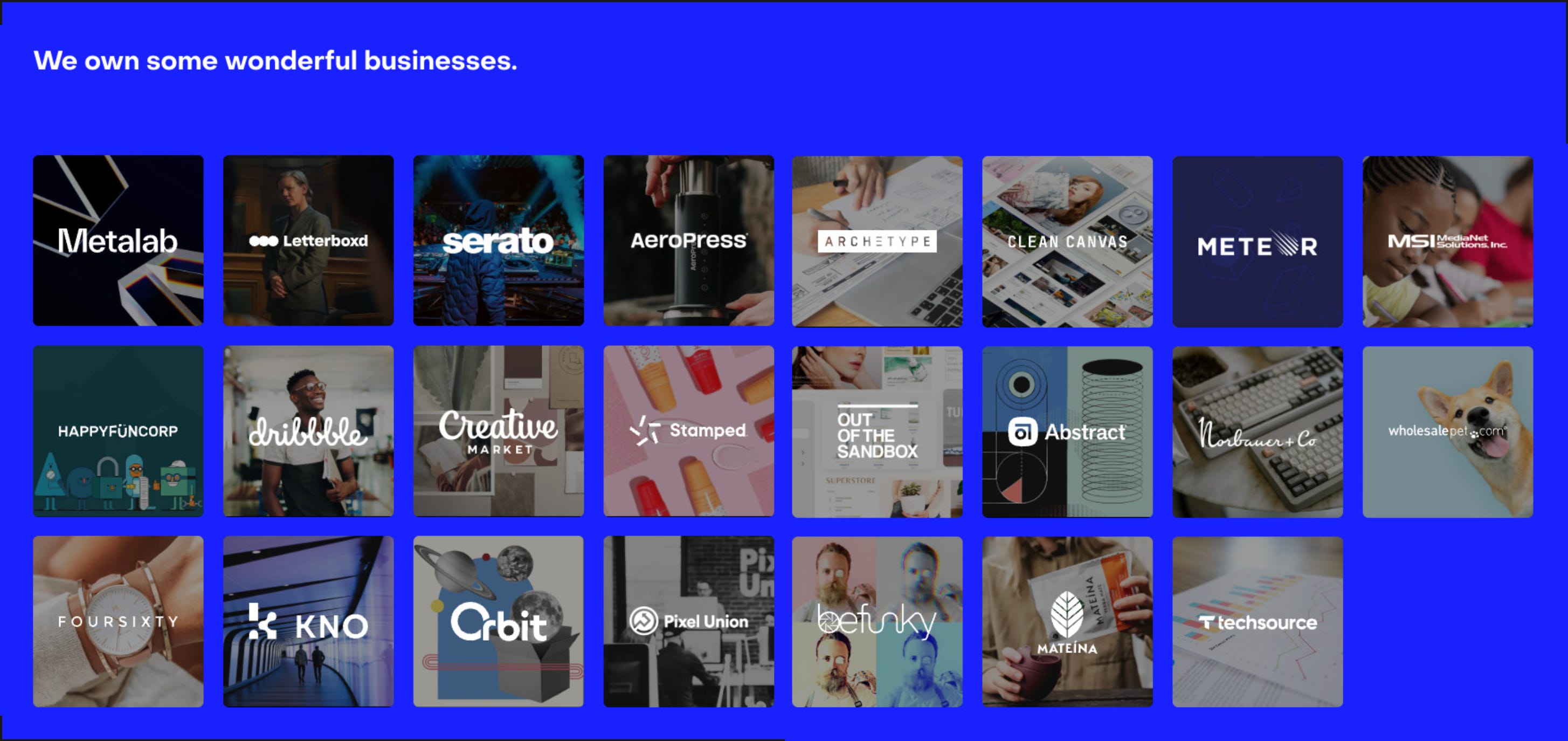
The company is Bending Spoons. You’ve probably never heard the name, but you’ve likely used one of its apps. It owns Evernote, WeTransfer, Vimeo, Meetup, StreamYard, Eventbrite, AOL, and over 40 other names. Its pitch is almost rude in its simplicity: buy beloved software that’s being run badly, fix the operations, raise the price, and keep it forever.
So here’s the question this filing finally lets us test: is Bending Spoons a genuine new citizen of Singletonville, a disciplined compounder that deserves a premium, or a financial engineering story being priced like one? I went in a skeptic. I came out mostly convinced. Let’s dig in.
the playbook
Strip away the industry, and every great serial acquirer runs the same three-step loop:
Buy a cash-generating business for less than it’s worth to you
Improve it — operationally, financially, or both
Take the cash it throws off and buy the next one
Repeat for decades. The magic isn’t any single deal; it’s the compounding, and the discipline to never overpay even when capital is cheap and everyone around you is doing exactly that.
Within that loop there are two schools. The first is hands-off: Warren Buffett at Berkshire Hathaway, Mark Leonard at Constellation Software. You buy good businesses and mostly leave the operators alone, while headquarters sets the capital allocation rules and stays out of the way. The whole thing runs on trust and a near-religious refusal to overpay.
The second is hands-on. Brad Jacobs, Danaher. These are operators who don’t just buy a business, they rebuild it. They centralize the back office, swap the management, impose a system. More execution risk, but far more margin to capture if you get it right. Jacobs’s one-line theory of the case has stuck with me:
“The easiest way to create tremendous shareholder value is to buy businesses at profit multiples lower than the multiple your own stock trades at, and then significantly improve those businesses.”
Bending Spoons is firmly in the second school, with two twists that make it both more interesting and more exposed. First, where Constellation buys mission-critical B2B software with brutal switching costs, Bending Spoons buys consumer apps – with lower switching costs, weaker pricing power, and users who can leave.
Second, where Constellation funds itself almost entirely from internal cash flow and runs little debt, Bending Spoons funds growth with bank debt, about $4.36 billion gross as of Q1 2026. It’s running the higher-risk version of the playbook on the lower margin of safety version of the asset.
In its letter to prospective shareholders, Bending Spoons names its influences directly: Singleton, Murphy, and the modern compounders Danaher, Broadcom, and TransDigm. Most of those names and most of that worldview come straight out of The Outsiders. Asked which of those role models he’d most want to resemble, CEO Luca Ferrari picks the one who made the leap from a scrappy real estate acquirer to a billion-dollar institution:
“There have been serially acquisitive compounders that have managed that transition successfully — one comes to mind, and that’s Danaher. They’ve been compounding for 30, 35 years at very good rates”
the milan machine
It’s the middle of the night on August 2, 2010, in Lombok, Indonesia. Three engineering grads on a backpacking trip, Francesco Patarnello, Matteo Danieli, and Luca Ferrari, are too excited to sleep, because they’ve just decided to start a company. Their first product was Evertale, an AI app that auto-generates a diary of your life.
Before they raised any outside money, the founders made a pact: whoever landed the highest-paying job offer would take it and bankroll the rest, so the others could work on the product full-time. Ferrari got the offer, from McKinsey. He took it, and worked on the startup on weekends while his salary kept the team going.
They’ve raised a $1 million seed round in February 2012, and by mid-2013, the startup has essentially no revenue and only months of runway left. They liquidate it and use the leftover $40,000 to start over, joined by two Evertale employees Luca Querella and Tomasz Greber. They name the new thing Bending Spoons – a metaphor for doing the seemingly impossible through sheer force of mind.
What they took from the wreckage became the entire thesis. Their Evertale post-mortem was that finding product market fit is mostly luck, but that operating a business well is a learnable skill that doesn’t depend on luck at all. So why keep betting on the lucky part? As Ferrari put it:
“We felt market fit was overwhelmingly luck… so [we’d outsource] finding product-market fit, and rather Bending Spoons would come in afterward to take something good and try to make it even better”
The first acquisition, in 2014, was a $10,000 iPhone keyboard app. They made about $20,000 on it, then did it again, and again. Ferrari explains the model very simply: “We acquire companies and improve them. Rinse and repeat.” What’s changed over thirteen years is the number of zeros, while the risk profile has remained similar.
From the outset they were explicit that the real product wasn’t any app, but rather the M&A process and the operating machine as their most important product. Thirteen years later, that machine is large.
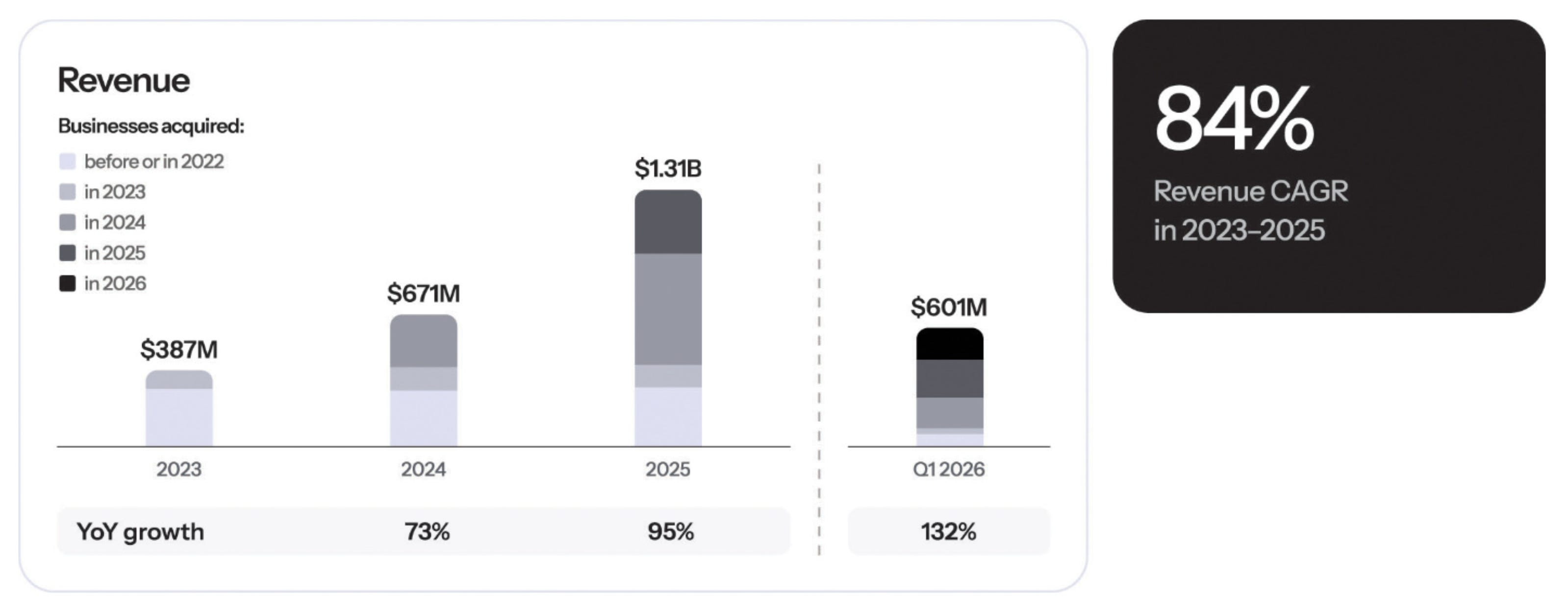
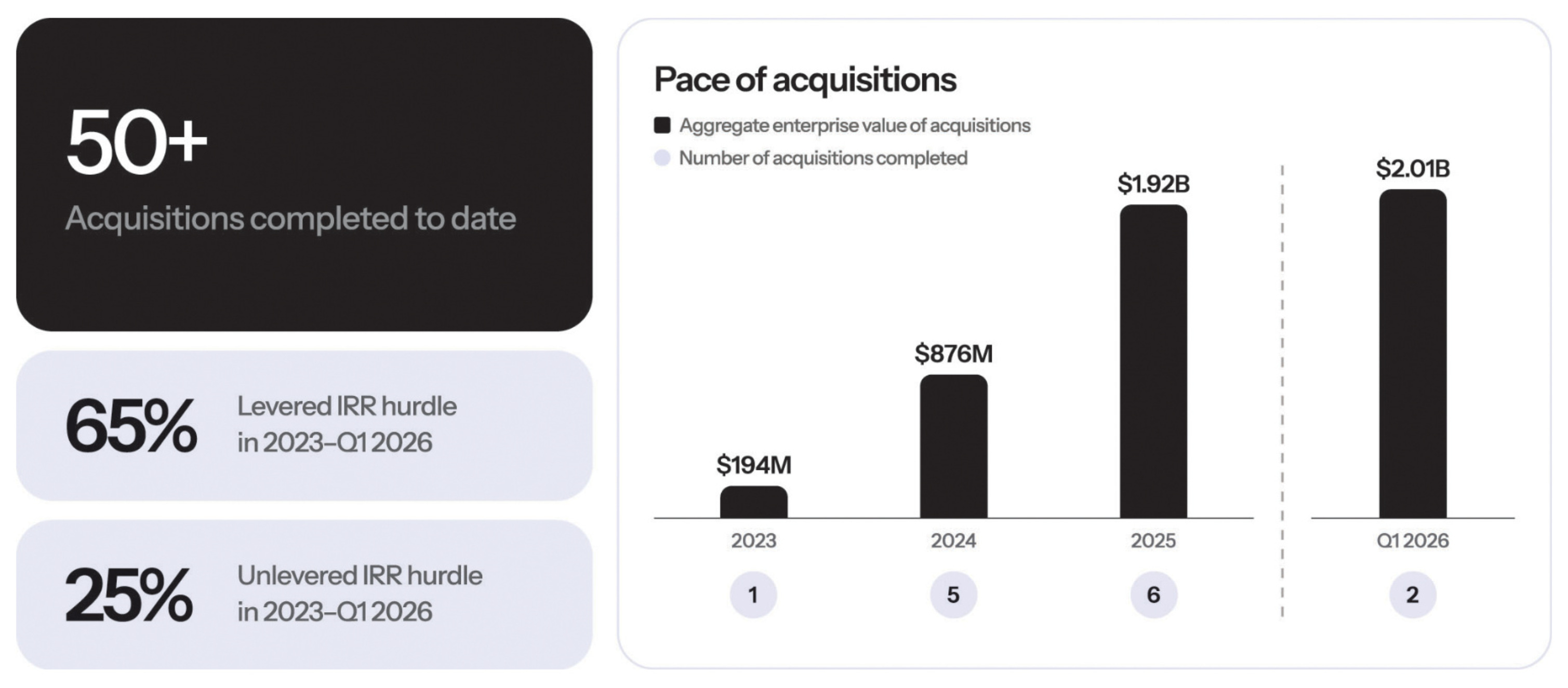
As of March 2026, Bending Spoons serves more than 500 million monthly active users and over 9 million paying customers. Revenue went from $387 million in 2023 to $671 million in 2024 to $1.31 billion in 2025 — an 84% compound growth rate — and the first quarter of 2026 alone did $601 million, up 132% year-over-year. It has made more than fifty acquisitions across those thirteen years, almost entirely funded off its own balance sheet, and it has done it from Europe, paying a fraction of Silicon Valley wages.
Through 2025, about 93% of revenue was subscriptions: recurring, auto-renewing, and exactly the kind of revenue you can reprice. The rest is advertising (AOL, Remini, WeTransfer) and a thin slice of “other” (mostly Eventbrite ticketing). That subscription share dipped to 84% in Q1 2026 only because AOL and Eventbrite had just landed and skewed the mix toward ads and ticketing; subscriptions are still the primary line in every business except Eventbrite.
The playbook hasn’t changed since 2013. What’s changed is how good they’ve gotten at the middle step. So let’s open up the machine.
acquire, transform and optimize, reinvest
i. acquire
Bending Spoons hunts for established apps being run below their potential. It has identified more than a thousand such targets, roughly $400 billion in aggregate annual revenue, and screens thousands a year to do a handful.
The handful that make it through have to clear three bars: the business has to be (1) digital and scalable, (2) predictable and (3) improvable. The current deal range is $50 million to $1.5 billion, and the hurdle rates are eye-watering, with internal rates of return of roughly 65% levered and 25% unlevered on deals since 2023.
Two things make the underwriting unusually rigorous. First, it’s done input-blind: “we debate assumptions extensively without ever looking at what the model will spit out… then we run a Monte Carlo simulation and look at the distribution of IRR and NPV — and that’s the truth.”
Second, and this matters for the valuation later, they say they underwrite to discounted cash flow, not to a future sale: they don’t speculate on what multiple they’ll exit at, because they don’t plan to exit:
“We don’t win because we’re good at predictions. We win because we can run them better, so we can offer a good price.”
ii. transform and optimize
Once it owns a business, a task force of engineers, product, design, and marketing people spends weeks “almost entirely in learning mode… in the trenches,” then designs “as close to the ideal version as possible” and rebuilds toward it. In practice that means a leaner, far more talent-dense organization and higher prices.
The repricing is defended by retention. At Evernote, Ferrari says, prices rose ~60% and “retention is at an all-time high… we did lose ~10% of customers who were already not so sure, but the more engaged customers are more satisfied than ever.” The data backs the stickiness: across the portfolio, the average subscriber tenure is 8 years, and net revenue retention is 95%.
When Bending Spoons takes over, a lot of people lose their jobs. An estimated 75% of WeTransfer’s staff, around 85% of Komoot’s, roughly a third of Brightcove’s, and most of Vimeo’s within months of closing. The founders’ argument is that most companies are simply overstaffed, and that smaller, more autonomous teams ship faster:
“We will make the change even if it’s unpopular, if it’s painful… and if we get criticized for it, I guess we’ll take it.”
The question that matters for an investor is whether it’s repeatable. Cutting staff and raising prices lifts margin immediately, but it also spends the goodwill that made the asset worth buying. However, it lets Bending Spoons keep improving the product, not just the cost line, so an asset can compound instead of being harvested once. Evernote, with prices up 60% and retention at an all-time high, says it can work.
iii. reinvest
Here is where Bending Spoons parts ways with private equity. It doesn’t flip what it buys. It doesn’t sell at all. As Ferrari puts it:
“We acquire to hold forever. We never sell — it may occasionally happen, but it’s never happened to any of our significant assets. We buy to keep for potentially decades.”
That permanence does two things. It reassures sellers, who know their team and product won’t be flipped in three years. And it turns Bending Spoons into a pure capital allocator: nothing ever leaves the portfolio, so every dollar that comes in has to be pointed at its single highest-return use. For now that’s almost always the next acquisition. But the founders are clear about where the discipline eventually leads.
They write that they “expect to allocate almost all available capital to acquisitions for many years to come,” and then, “like Singleton and Murphy, perhaps our best acquisition opportunity will be the shares of our own company.”
the AI engine
Bending Spoons has used machine learning since the Evertale days, but the filing discloses something striking: the share of its code authored or co-authored by AI went from under 10% in early 2025 to more than 90% a year later, with around 70% written by AI alone.
For context, Google recently said ~75% of its code is now AI-generated and Microsoft ~30%. The edge compounds: Ferrari argues that AI “makes a great engineer better by 10 times” while doing far less for a mediocre one, which rewards the elite team Bending Spoons has built.
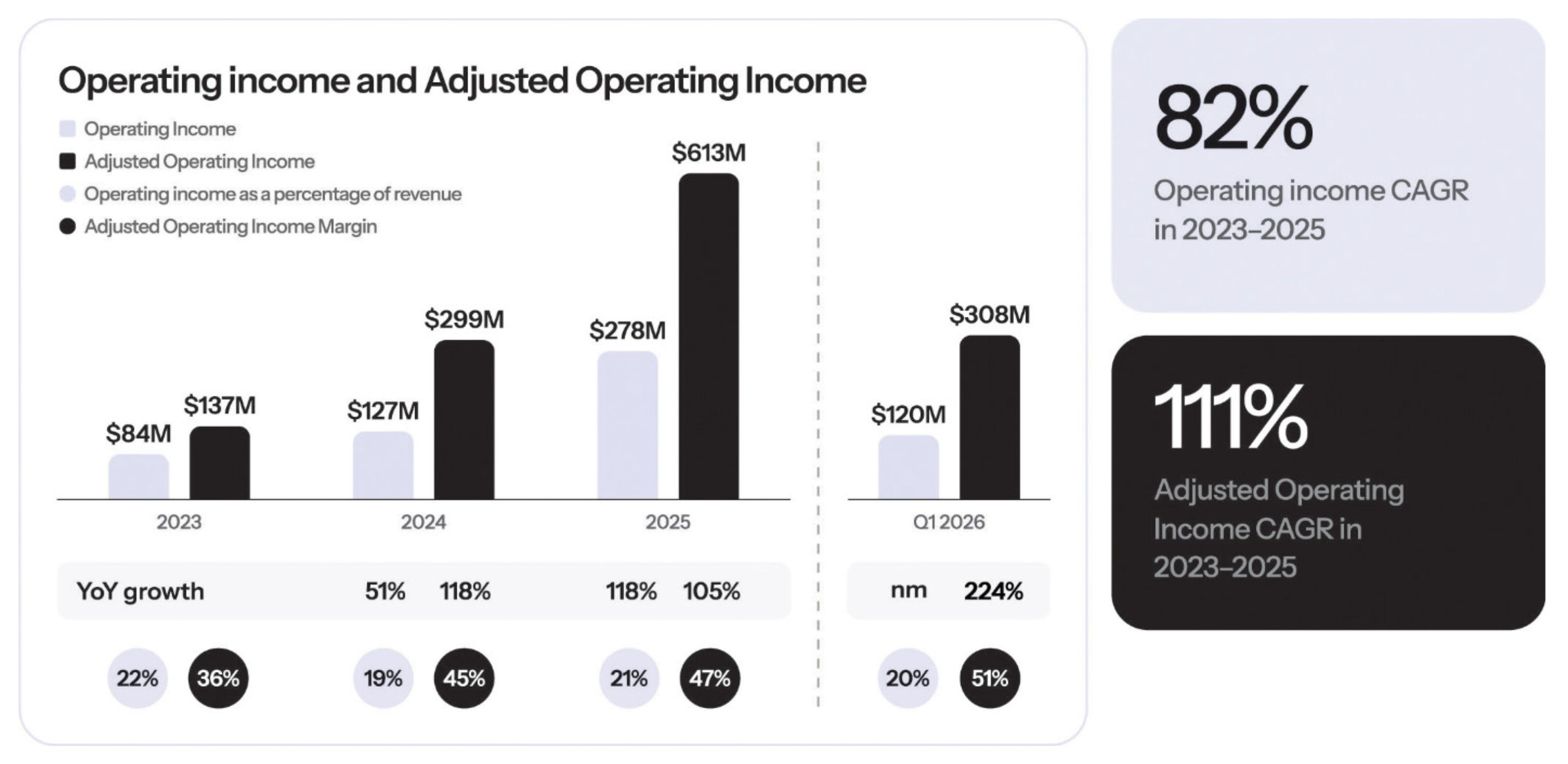
The result shows up in the margins. Adjusted operating income went from $137 million in 2023 to $613 million in 2025 – a 111% CAGR, far outpacing revenue, and adjusted operating margin climbed from 36% in 2023 to 51% in Q1 2026.
One number got quoted a lot when the filing dropped: $2.57 million of 2025 revenue per “Spooner,” the company’s name for its core team. It’s worth being precise about it. Spooners are only about 27% of full-time staff, and there are roughly 2,300 employees once you count everyone running the acquired businesses. Spread across all of them, revenue per head is closer to ~$570,000, about a quarter of the headline figure. So the $2.57 million measures the central team’s leverage, not the whole organization’s.
Either way, the structure underneath is straightforward: a (relatively) small core team, paid European wages rather than Bay Area ones, using AI to do more per person, running apps that already arrived with their audiences. Cheaper inputs, more output per head, demand they didn’t have to build.
financing
As of Q1 2026 the company carried about $4.36 billion of total debt against $741 million of cash (net debt around $3.6 billion), at a leverage ratio of 2.19x against a covenant that allows 4.0x. That ratio is measured against a generous, credit-agreement “adjusted EBITDA” that bakes in a full year of acquired earnings and projected cost savings, so the reported-basis leverage is higher. But the picture is a company that is levered, not recklessly so. As CEO Ferrari puts it:
“We use debt… never to extreme leverage ratios, normally up to maybe three times at most. By the way, I think we should have done more of that, and we will try to do more in the future”
profitability
Is Bending Spoons profitable? At the operating line, clearly. The bottom line carries a nuance worth knowing. Net income for 2025 was essentially zero, because operating profit was absorbed by about $143 million of interest and a one-time $111 million tax charge tied to moving acquired businesses into Italy. The one-time charge passes. The interest doesn’t. So “profitable” is solidly true at the operating line and still aspirational at the very bottom.
the second act test
The fastest way to understand Bending Spoons is to look at what it actually owns. The portfolio is more diversified, and each piece better defended, than a roster of overlooked apps suggests. The pattern is consistent. Each one was genuinely beloved at its peak, then under-invested inside a larger owner that stopped paying attention, which is why Bending Spoons could buy it at a discount. What protects each one differs, and that’s the point.
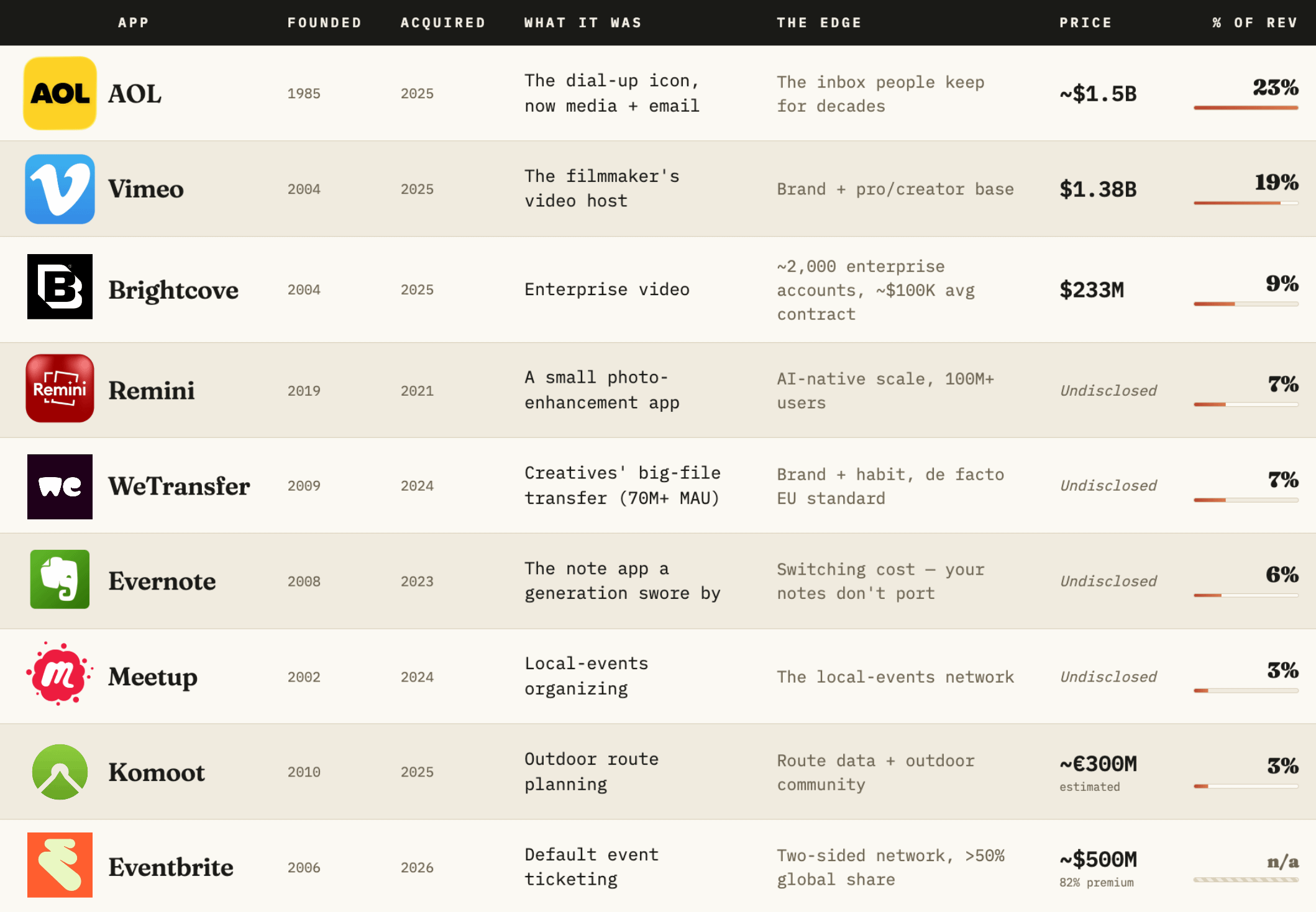
What I care about most is whether these have a future, not just a present, and here the portfolio splits cleanly. A few are genuine AI second acts, where Bending Spoons didn’t just cut cost but rebuilt the product into something it couldn’t have been before.
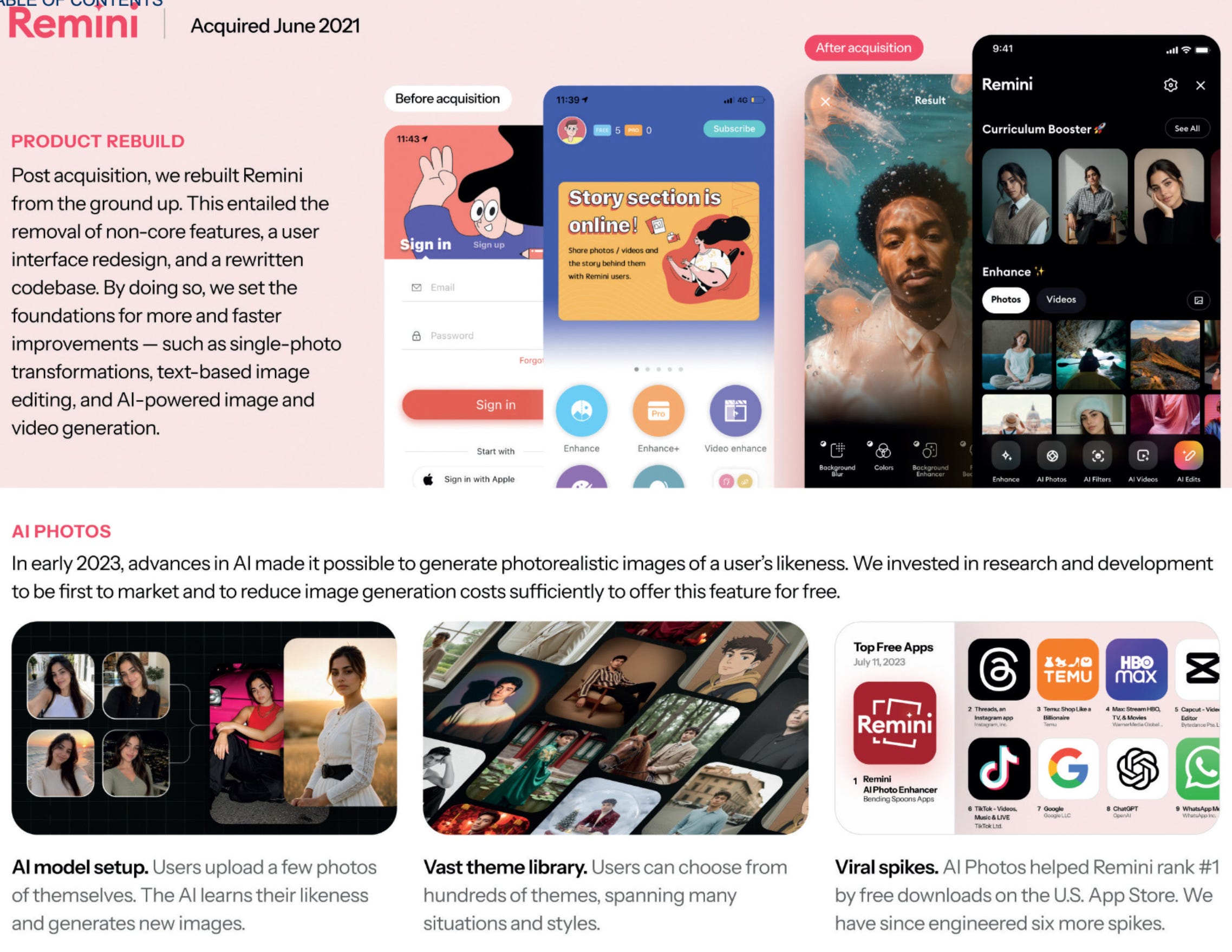
Remini is the one that worked beyond anyone’s expectations. Bending Spoons bought it as a small photo enhancement app and rebuilt it from the ground up, stripping non-core features, redesigning the interface, and rewriting the codebase. Then, once AI could generate photorealistic images of a person from a handful of selfies, they invested to get there first and drove the cost of generation low enough to offer it free.
In 2023, AI Photos sent Remini to number one on the US App Store, above Threads, ChatGPT, and TikTok, and the team has engineered more viral spikes since. It now has more than 100 million users and ranks among the most-used consumer AI products in the world. This is the proof the playbook can manufacture upside, not just margin.
Since acquiring Evernote, Bending Spoons redesigned the desktop and mobile apps, expanded the feature set, and built AI into the product. They indexed every user’s notes, around 3.2 billion of them, so the app can be searched by meaning rather than by keyword, and brought an AI assistant, meeting transcription, and synthesis directly into the product.
It’s even shipping an official MCP server, the emerging standard that lets AI agents plug straight into an app, which is about as agent-era as a fifteen-year-old note app gets.
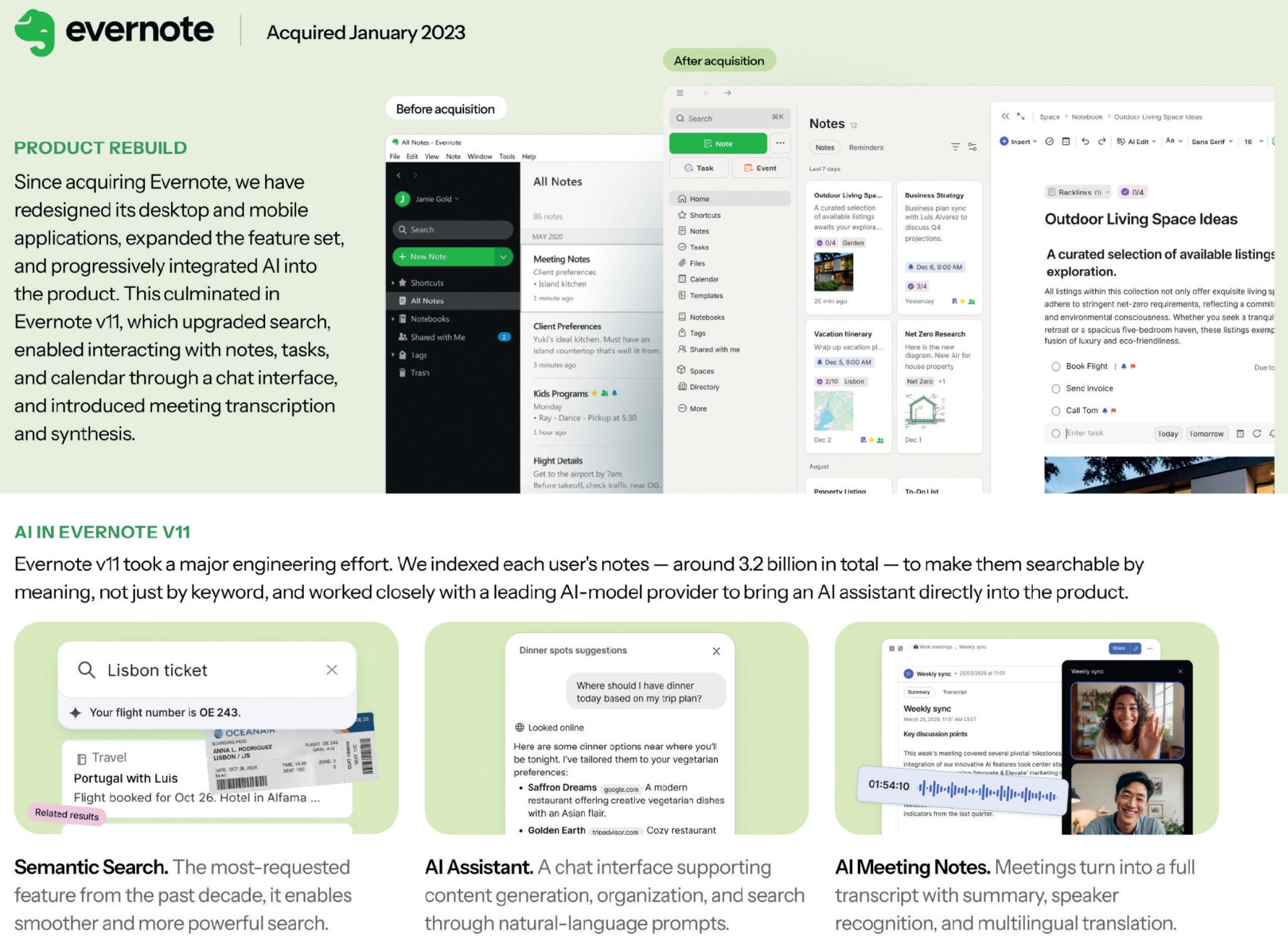
Not every asset gets a second act, and that is fine. AOL has no AI angle at all, but it has the stickiest position in the set, an inbox people keep for decades. WeTransfer’s one AI move, a change to its terms that looked like it claimed rights over users’ files, was reversed within days. Vimeo’s and Eventbrite’s AI tooling mostly predates the acquisitions. So the bet isn’t that AI revives every app, and rather that the portfolio is a diversified set of defensible positions, switching costs, networks, brands, and annuities, with real AI optionality on top.
the premium question
In November 2025, a round led by T. Rowe Price valued Bending Spoons at $11 billion. The IPO is reportedly targeting around $20 billion. So the real question isn’t whether $20 billion is defensible in the abstract, it’s whether the jump in roughly six months is. Part of that is mechanical, the $11 billion mark predates AOL, Eventbrite and Tractive, so it valued a meaningfully smaller company than the one filing today. The rest comes down to the multiple.
And the multiple is where it gets hard, because Bending Spoons has no clean comparable. It’s a programmatic acquirer, but of consumer apps rather than B2B software, and increasingly operated by AI. The closest public analogs fall into two camps, and neither fits cleanly: disciplined software compounders, and consumer internet holding companies.
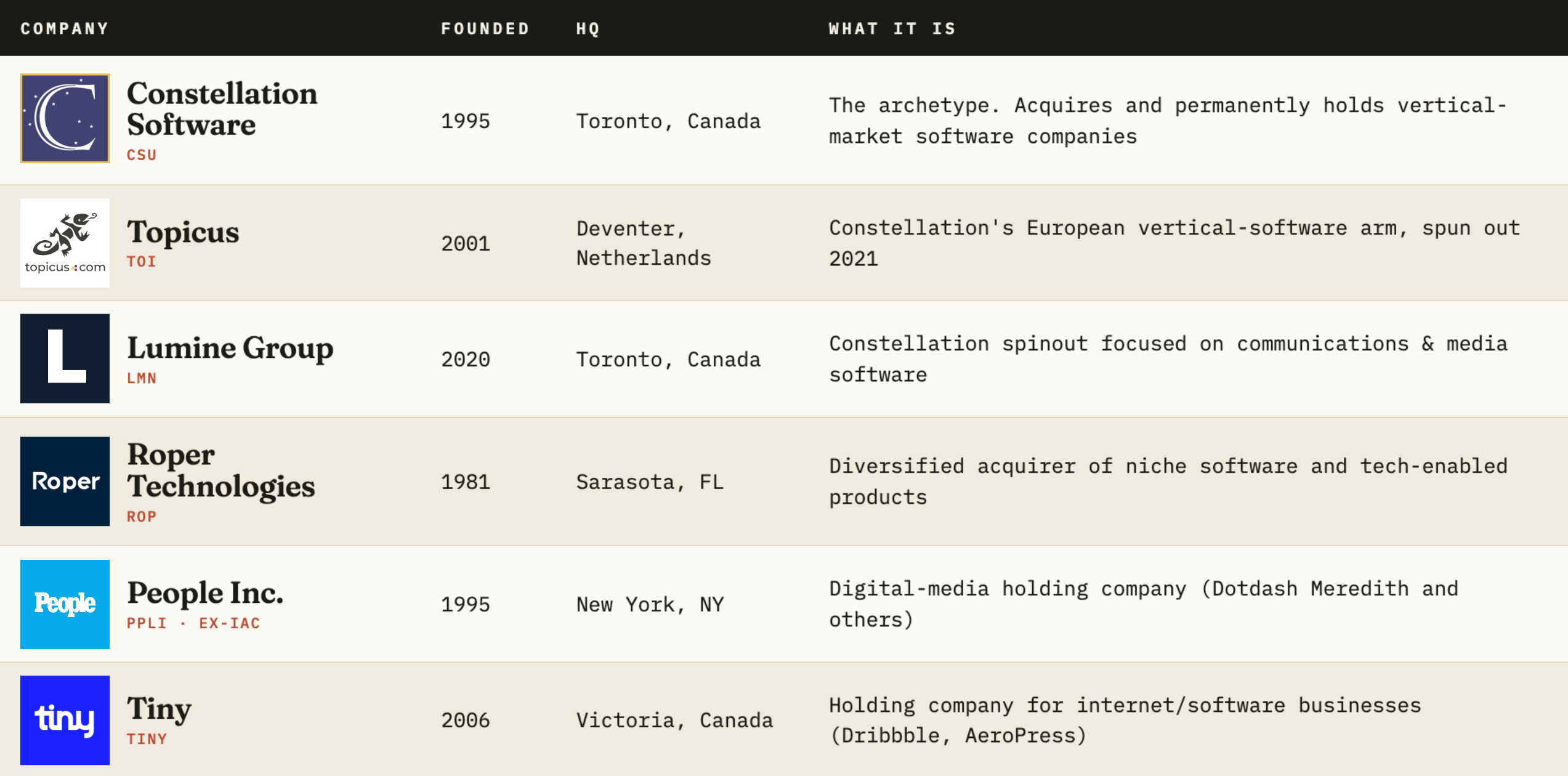
In the first camp sits Constellation Software, the archetype, with its spinouts Topicus and Lumine, alongside Roper, a US acquirer of niche software and tech-enabled businesses. In the second are People Inc. (the former IAC), a digital-media holding company, and Tiny, a microcap holder of internet and software businesses.
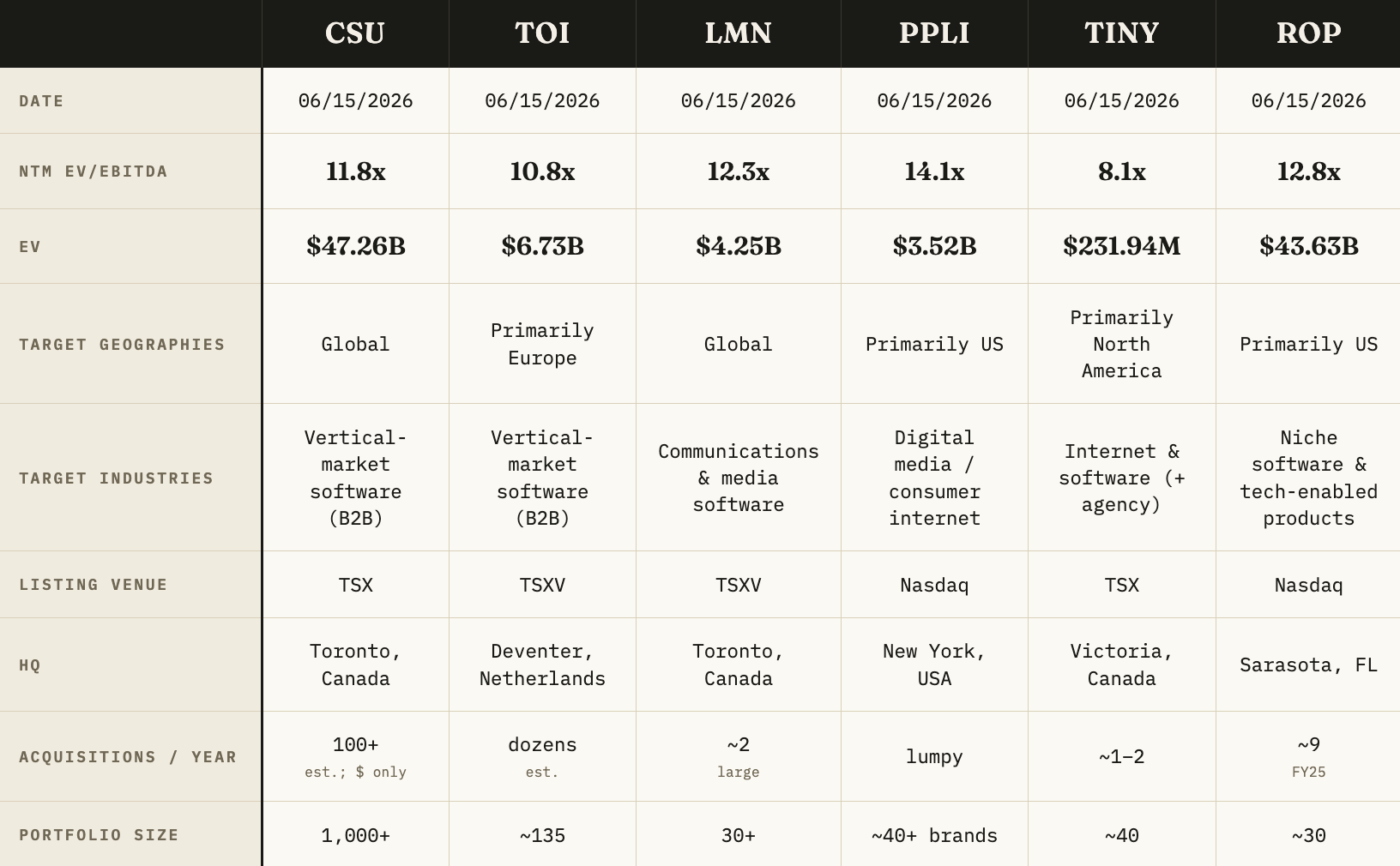
On the numbers, the software compounders trade around 3-5x EV/Sales and 11-13x EV/EBITDA, and they’re all 40-50% off their highs, beaten down on fears that AI commoditizes the vertical software they own.
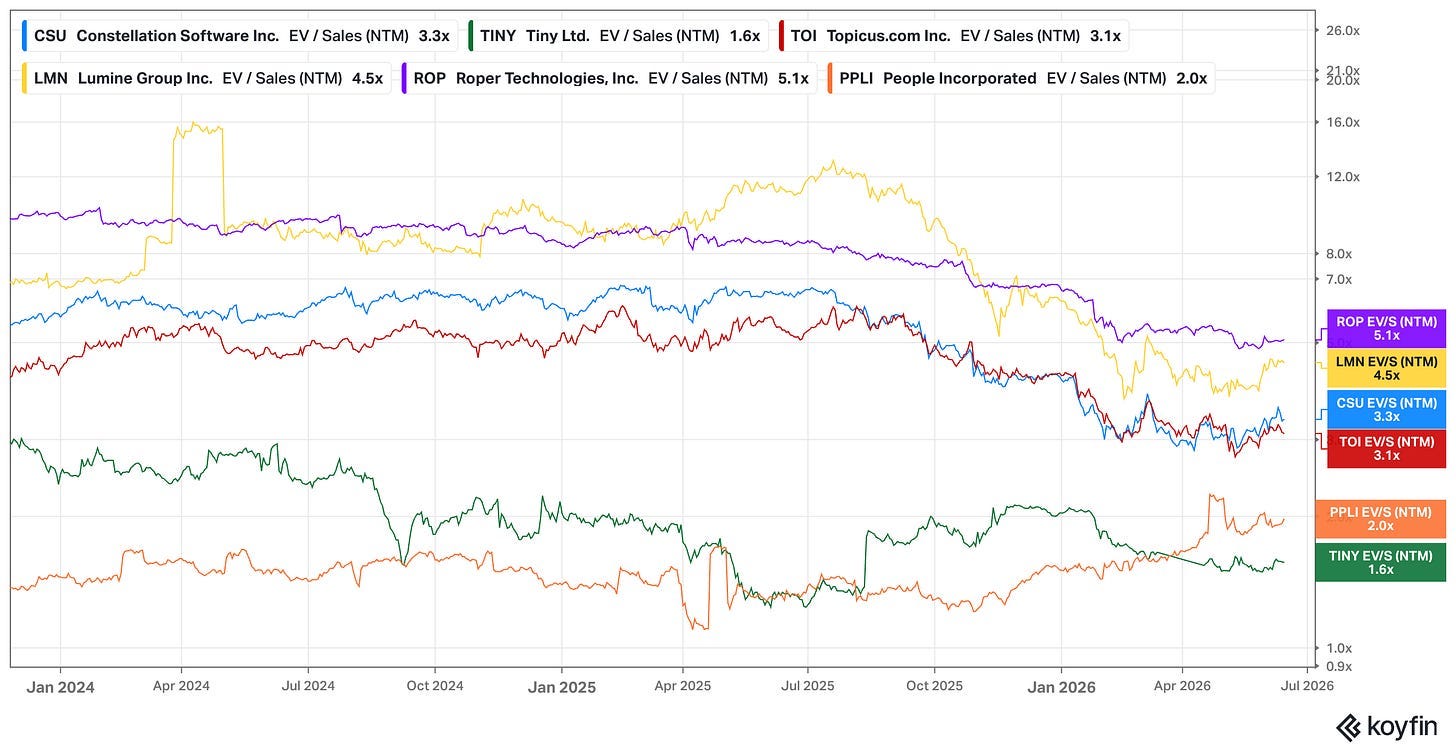
So where does Bending Spoons land? On revenue, it looks expensive. Its target $20 billion of equity plus about $3.6 billion of net debt is around $23.6 billion of enterprise value, against pro-forma revenue of ~$2.6 billion, or about 9x sales, well above the 3-5x band.
On earnings the gap narrows but doesn’t close. Bending Spoons doesn’t disclose a clean EBITDA, so the closest proxy is adjusted operating income, which on a forward basis runs to roughly $1.5 billion: Q1 2026 alone produced $308 million of it at a 51% margin, and run forward through a year of continued growth, that’s about where it lands.
Against the ~$23.6 billion enterprise value, that works out to around 15-16x, still a premium to the 11-13x cluster (and a generous read, since the figure adds back the transaction and reorganization costs a serial acquirer pays every year). Additionally, this is operating income, not EBITDA: add back D&A and the true EV/EBITDA would screen below 15-16x, narrowing the premium gap.
I think it earns one. The comps are priced as what they are: mature, slow-growing, hands-off holders, marked down precisely because AI threatens the software they own. Bending Spoons is the inverse on every axis that moves a multiple. Its operating margin is around 50%, roughly double the group and still rising.
Its earnings compounded at 111% over the last three years, against single digits for the comps. And AI, the force dragging the compounders down, could widen Bending Spoons’ margins and turn the businesses it disrupts into willing, cheaper sellers. A company growing earnings this fast, at that margin, shouldn’t trade at the multiple of one that is under threat.
Additionally, going public should lower Bending Spoons’ cost of capital, since a listed, more transparent issuer is a safer credit, and cheaper debt makes every future acquisition more accretive.
None of this makes $20 billion a sure thing. It’s a premium to a beaten-down peer set, on a company carrying real leverage and a thin GAAP bottom line. But the gap from $11 billion to $20 billion is really the market deciding whether to price the machine or the snapshot. I would take the former.
the bear case
Two levered roll-ups get thrown at any thesis like this one, and although neither is really Bending Spoons, both are worth taking seriously. Thrasio was an ecommerce play that rolled up hundreds of Amazon third-party brands on cheap debt, cut costs, raised prices, and grew at a frenzy, valued at nearly $10 billion before rates rose, demand softened, and it filed for bankruptcy in 2024.
Tiny is a microcap that bundled small internet businesses and a design agency under the same hold-forever philosophy Bending Spoons preaches. It’s trading at roughly 98% from its 2021 peak, at ~1.6x sales, with close to 10x leverage and negative returns on capital.
Bending Spoons is genuinely different on the things that matter. It buys subscription software with 95% net revenue retention and an 8-year average subscriber tenure, and it owns its customers directly rather than renting demand from a platform. More importantly, it rebuilds what it buys instead of just holding it: the ~50% margins, the AI-authored codebase, and the constant reallocation of talent are what separate a compounding machine from a levered pile of assets.
The difference is real, but not infinite. What sank Thrasio was the leverage meeting a rate shock and shrinking cash flows, and Bending Spoons carries the same exposure. S&P rates its debt B+, and on a stricter EBITDA puts leverage above 4x. The acquired apps grow only 3-5% on their own, so the whole thesis rests on the acquisition engine never stalling.
a new citizen of singletonville?
So, back to the question I opened with. Run Bending Spoons against the Outsiders’ own scorecard and the fit is hard to miss. The Outsider CEOs shared five habits, and Luca Ferrari, as CEO of Bending Spoons, has nearly all of them:
Decentralized operations: Each business runs semi-autonomously under a small, Spooner-led team, and the company is explicit that these core “Spooners” are a distinct tier from the staff it inherits at the acquired companies.
Centralized capital allocation: Cash and talent are pulled to the center and redeployed wherever the return is highest, what Ferrari calls the company’s “private-equity soul.”
Buybacks and acquisitions: Acquisitions are the entire growth engine, financed with bank debt, and the founders flag their own undervalued stock as a potential future buy.
Limited payouts: No dividend; every dollar of cash is recycled into the next deal.
Low-profile and independent: The independence is unmistakable, hiring for talent over experience, no KPIs, a stated conviction that most R&D is wasted. Low-profile is the looser fit: Luca Ferrari and the company have done plenty of interviews and podcasts, and the IPO ends any under-the-radar status that remained.
The risks are real, and I won’t wave them away. The leverage is genuine, the assets are (arguably) easier to walk away from than enterprise software, the bottom line is still thin, and the model has to keep buying to grow. On balance, I think Bending Spoons earns its Singletonville citizenship.
There’s no public price to call cheap or rich yet, and the only outside read so far is S&P’s credit rating. What we do have are two marks: the $11 billion the private market paid last year, and the $20 billion the IPO is reportedly seeking. The gap between them is the public market deciding whether it believes the compounding.
If it does, “boring, levered, brilliantly-operated acquirer of unloved apps” becomes a fundable public story, and the founders now building software holding companies and AI-native rollups get a public template to point to.
Singletonville always had a high bar for membership. Bending Spoons just submitted its application to the toughest admissions committee there is — the public market. I think it gets in. We’ll find out when it prices.
Thank you for reading!
— E
* For transparency: I own shares in QXO, which is mentioned above. None of this is investment advice, just me sharing how I think about a company I find fascinating.
As always, do your own research.